Contact Us For Consulting!
We are here to help you. You can reach us from the section below.
I consent to the processing of personal data and accept the user agreement and privacy policy


Showing all 4 resultsSorted by latest

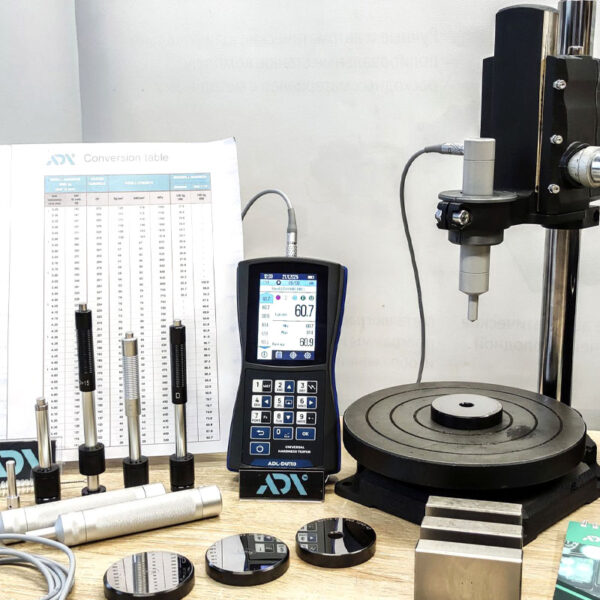
A hardness tester is a device used to determine the hardness of a sample by non-destructive force on its surface. The aim is to provide quality control of raw materials, blanks and end products of production in the engineering, railway, energy and other sectors, as well as to provide the necessary data when developing new materials and structures.
The essence of the test using a hardness tester is the mechanical impact on the material or product, the subsequent removal of the necessary measurements and calculations based on the data obtained. To implement such work, the device is equipped with:
This list includes only the main components of the device. It depends on the type of complex.
According to the working conditions, hardness testers are divided into fixed and portable. The first is distinguished by impressive dimensions, large weight, rich functionality, high measurement accuracy. Portable ones are very compact, light, sensitive enough and at the same time easy to use. They are easy to use in the field.
Research methods play a decisive role in dividing hardness testers into groups according to design. Therefore, their names are assigned to the respective device types. In particular, the popular and reliable Adelix fixed hardness testers for testing metals and alloys are divided into hardness testers:
Portable hardness testers are divided into dynamic, ultrasonic, combined according to the methods used in their work. Devices of the second type, together with universal fixed ones, can work in different modes, as they are able to give results at various scales. This feature removes the restrictions on usage areas and contributes to the constant interest of consumers.
Before you buy a hardness tester, you should decide on its type. To test soft metals, alloys and products made from them, devices operating according to the Brinell method are used. The properties of medium hard materials are checked using Rockwell instruments and very hard materials - Vickers.
If there are studies on different samples, then it is better to stop the choice on universal devices of a fixed type. It is also worth paying attention to:
To purchase a portable hardness tester, it is also worth deciding on the type. There are the following types of portable hardness testers:
A portable hardness tester is used to quickly measure the hardness of metals, metals and non-metals, including surface-hardened layers (cementation, nitriding, HDTV hardening, etc.), galvanic coatings (chrome), surface coating, mechanical strength evaluation.
Information about these and other parameters of the hardness testers are indicated on the product cards.
If you want to clarify or consult an expert, call for feedback or submit a request.
We will not only provide comprehensive answers, but also assist with ordering, delivery of equipment to the laboratory, commissioning and organization of maintenance.
To purchase a hardness tester for metal (portable hardness tester or stationary hardness tester), contact Adeliks, Ankara in any way convenient for you: by phone or via the feedback form.
The hardness tester is delivered to all cities of Turkey: Istanbul, Izmir, Ankara, Bursa, Belek, Kelkit, Konya and other cities.