Contact Us For Consulting!
We are here to help you. You can reach us from the section below.
I consent to the processing of personal data and accept the user agreement and privacy policy

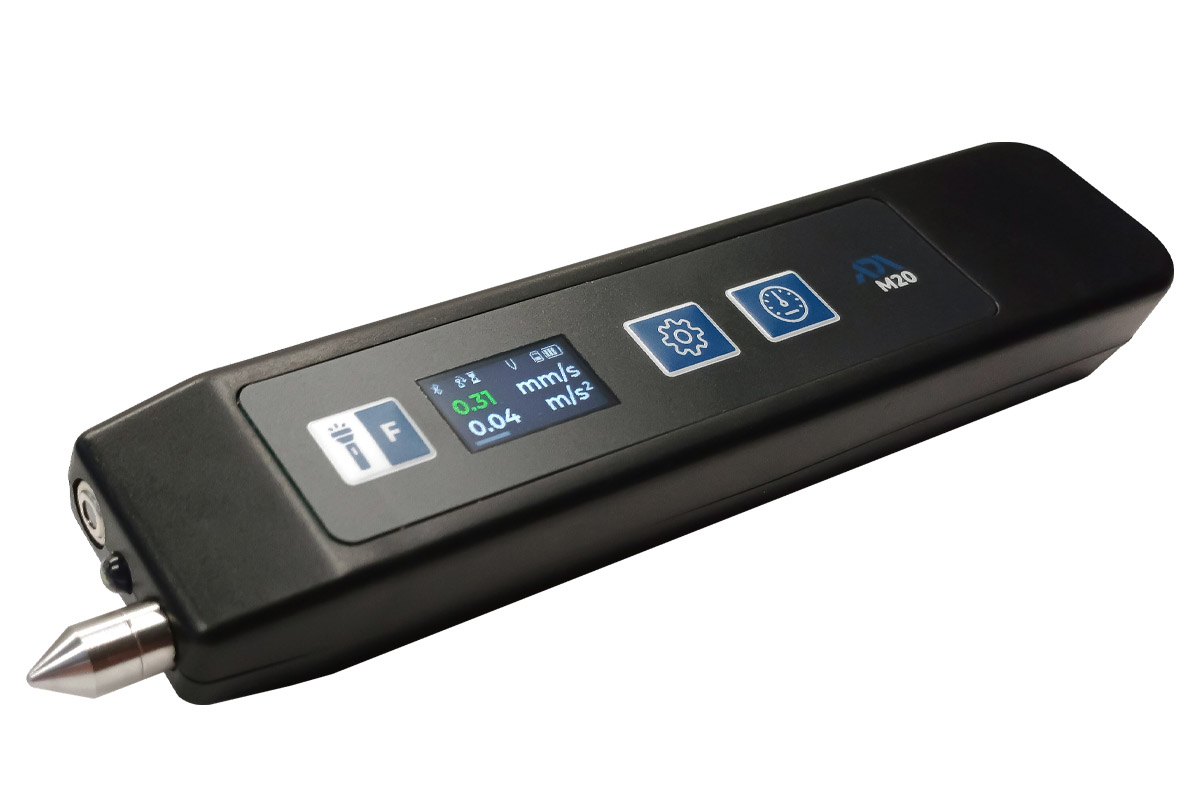
Measurement of the SCR of vibration velocity, vibration acceleration, vibration displacement. Measurement of surface temperature. Data transmission via Bluetooth.
The ADL-M20 vibration meter enables real-time monitoring of the mechanical condition during operation, diagnostics, maintenance and repair of equipment: bearings, gearboxes, turbines, generators, pumps, rotors, distribution units, etc. The device is suitable for monitoring both entire structures and individual components.
This vibrometer is used in sectors such as metallurgy, mechanical engineering, petrochemicals, thermal and nuclear power, light and food industries, agricultural complexes, transport, housing and communal services, etc.
The device can operate in classic vibrometer mode, providing monitoring of overall vibration levels, measurement of peak values and analysis of equipment condition.
The device also supports route mode, allowing equipment condition monitoring to be carried out along pre-defined routes without the use of additional equipment.
In addition, contactless temperature measurement is available.
Measurement data is automatically recorded in the device’s built-in memory and subsequently transferred to specialised software for analysis and storage. This makes the device a convenient tool for quick and accurate equipment diagnostics.
The vibrometer is capable of wireless data transmission to mobile devices (Android, iOS) thanks to built-in Bluetooth (the device can be customised to meet the Customer’s specific requirements).
No specialised skills or qualifications are required to operate the ADL-M20 portable vibrometer. The device can be used by frontline staff after a brief familiarisation with the instructions.
Thanks to its simplicity and functionality, the ADL-M20 helps avoid unnecessary costs associated with expensive repairs or the purchase of new equipment due to serious breakdowns and accidents. It also eliminates losses incurred by businesses due to unauthorised equipment downtime.
Parameter | Value |
| RMS value of vibration velocity | 0.01-200mm/s |
| RMS value of vibration acceleration | 0.1-200 m / s2 |
| The scope of vibration displacement | 2-2000mkm |
| Relative error | +5 % |
| Operating frequency range | 10-1000 Hz |
| Temperature measurement range | from -20 to +200°C |
| Accuracy of temperature measurement | 0.5 °C |
| Display type | OLED, 0.96” |
| Display Size | 128×64 mm |
| Li-ion battery | 3.7V, 600 mAh |
| Connector | USB Type-C |
| Compatibility | Android, iOS |
| Wireless communication module | Up to 10m |
| Bluetooth Low Energy (BLE) | |
| Continuous operation time | 8 hours |
| Environmental conditions | |
| – temperature | -10 – 55°C |
| – relative humidity | < 85 % |
| Degree of protection | IP54 |
| Overall dimensions | 170x36x20 mm |
| Weight | 100 g |
| Brand | Adelix |
|---|

ADELIX is an international company headquartered in Ankara, Türkiye. It specializes in the design and manufacture of equipment for mechanical testing, chemical analysis, non-destructive testing of materials and products, as well as for the diagnosis and control of units.
The company's team effectively solves both standard and individual client tasks. First of all, it provides technical support during the formulation of a technical problem, selection of equipment, methods of writing, and then training of personnel, as well as during the operation of devices. Project development, preparation of technical documentation, installation, installation supervision, full technical and metrological support of the laboratory.